
Implications of Bitten’s Werewolves

Laura Vandervoort as Elena Michaels.
Film and TV werewolves have mostly been ordinary people inadvertently infected by the bite of another, often when trying to rescue someone else from being devoured. Curt Siodmak created the template with his 1941 screenplay for THE WOLF MAN. The verse below, uttered by many in that film (but most effectively by Maria Ouspenskaya), cautioned that no one is immune to the werewolf curse (except perhaps women).
“Even a man who is pure in heart
And says his prayers by night
May become a wolf when the wolfbane blooms
And the autumn moon is bright.”
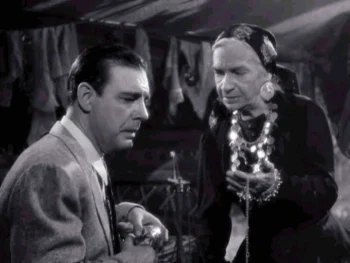
Maria Ouspenskaya as Maleva and Claude Rains as Sir John Talbot
Except for the gender preference, the werewolves of BITTEN, a 33 episode TV series based on novels by Kelley Armstrong, don’t fit Siodmak’s template. They inherit their lycanthropic talents; they remember what they have done when in wolf form; and they have some of their wolf powers when in human form. They are mean, vicious, violent creatures, and these are human, not wolf, characteristics. They behave like mobsters, ruthlessly torturing and killing their enemies. Elena (Laura Vandervoort) had a human fiance (Phillip, played by Paul Greene) at the beginning of the series, but the ‘pack’ disapproved, and, at the end of Season One, Elena found Philip’s severed head in her bed.
Elena retains her blue eyes when in wolf form, though wolves, unlike some dog species, do not have blue eyes.
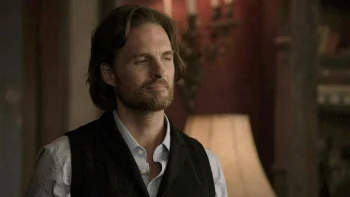
Jeremy Danvers (Greg Bryk)
As Farley Mowat put it in Never Cry Wolf: “We have doomed the wolf not for what it is, but for what we deliberately and mistakenly perceive it to be – the mythologized epitome of a savage ruthless killer – which is, in reality, no more than a reflected image of ourself.”
Female werewolves are rare in the BITTEN universe. Women can become infected, but most do not successfully make the transition to wolf form. Elena is an exception, and because of that seems destined to become pack leader. (There have been plenty of female werewolves in cinema, the most memorable being Julie Delpy’s Seraphine in AN AMERICAN WEREWOLF IN PARIS.) The mother of Bitten’s pack leader Jeremy Danvers (Greg Bryk) is a Kitsune.
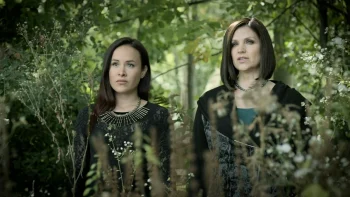
Ruth and Paige Winterbourne
Witches enter Bitten in the second season in the persons of Ruth Winterbourne (Tammy Isbell) and her daughter Paige (Tommie-Amber Pirie). They exhibit the ability to make people see what is not there, and are adept at telekenesis. These witches only have female children. They inherit their powers, and assert that both they and the wolves are from the ‘other world’. Does this mean another planet? Another plane of existence? Another dimension? The witches reproduce sexually, whereas the werewolves expand their population by either mating with humans (only their male offsprings inherit the gene) or by biting humans. Their bite likely communicates lycanthropy by means of a virus, bacterium, or parasite, but this is not specified. Both males and females can be infected, but female werewolves are few, because most women do not survive their first shapeshifting experience.
Non-human Alphas
Bitten’s werewolves are led by alphas (not always male), and exhibit the most undesirable qualities of alpha male humans. The tale of The Keekorok Baboons seems relevant.
About 45 minutes into the 2008 National Geographic documentary STRESS: PORTRAIT OF A KILLER, Stanford neurobiologist Dr Robert Sapolsky, who spends a lot of time studying baboons in Kenya, tells a story that might have implications far beyond stress reduction. The story involves the unexpected results of a disaster that befell a troop of baboons he had been studying for many years.
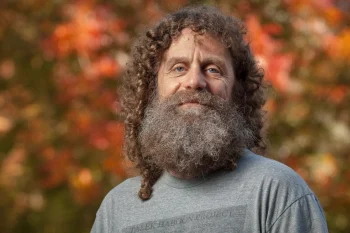
Dr. Robert Sapolsky
“They were your basic baboon group at the time,” said Sapolsky, “which means males were aggressive and the society was highly stratified. Females took a lot of grief…And then, almost 20 years ago, something horrific and scientifically very interesting happened to that troop. The keekorok troop took to foraging for food in the garbage dump of a popular tourist lodge. It was a fatal move. The trash included meat tainted with tuberculosis. The result was that nearly half the males in the troop died.”
“It wasn’t random who died. In that troop, if you were aggressive, and if you were not particularly socially connected, if you did not spend your time grooming and hanging out, if you were that kind of male, then you died. Every alpha male was gone. The keekorok troop had been transformed, and what you were left with was twice as many females as males, and the males that were remaining (just to use scientific jargon) were good guys. They were not aggressive jerks. They were nice to the females. They were variously affiliated. It completely transformed the atmosphere of the troop…The baboons of this group have a culture with very low levels of aggression and high levels of social affiliation. They’re still doing that 20 years later.”
On the relevance of baboons
“The ability to build up knowledge over generations, called cumulative culture, has given humankind language and technology. While it was thought to be limited to humans until now, researchers have recently found that baboons are also capable of cumulative culture.”
— Science Daily – 5 November 2014
“The baboon is the most commonly used primate model for genetic studies of complex traits and susceptibility to complex diseases. This is, in large part, because of the many anatomic, physiologic, and genetic similarities between human and baboon, which facilitate translation of findings in baboons to humans.”
— The Baboon in Biomedical Research (2009)
** — Revised. Originally published on 16 February 2015